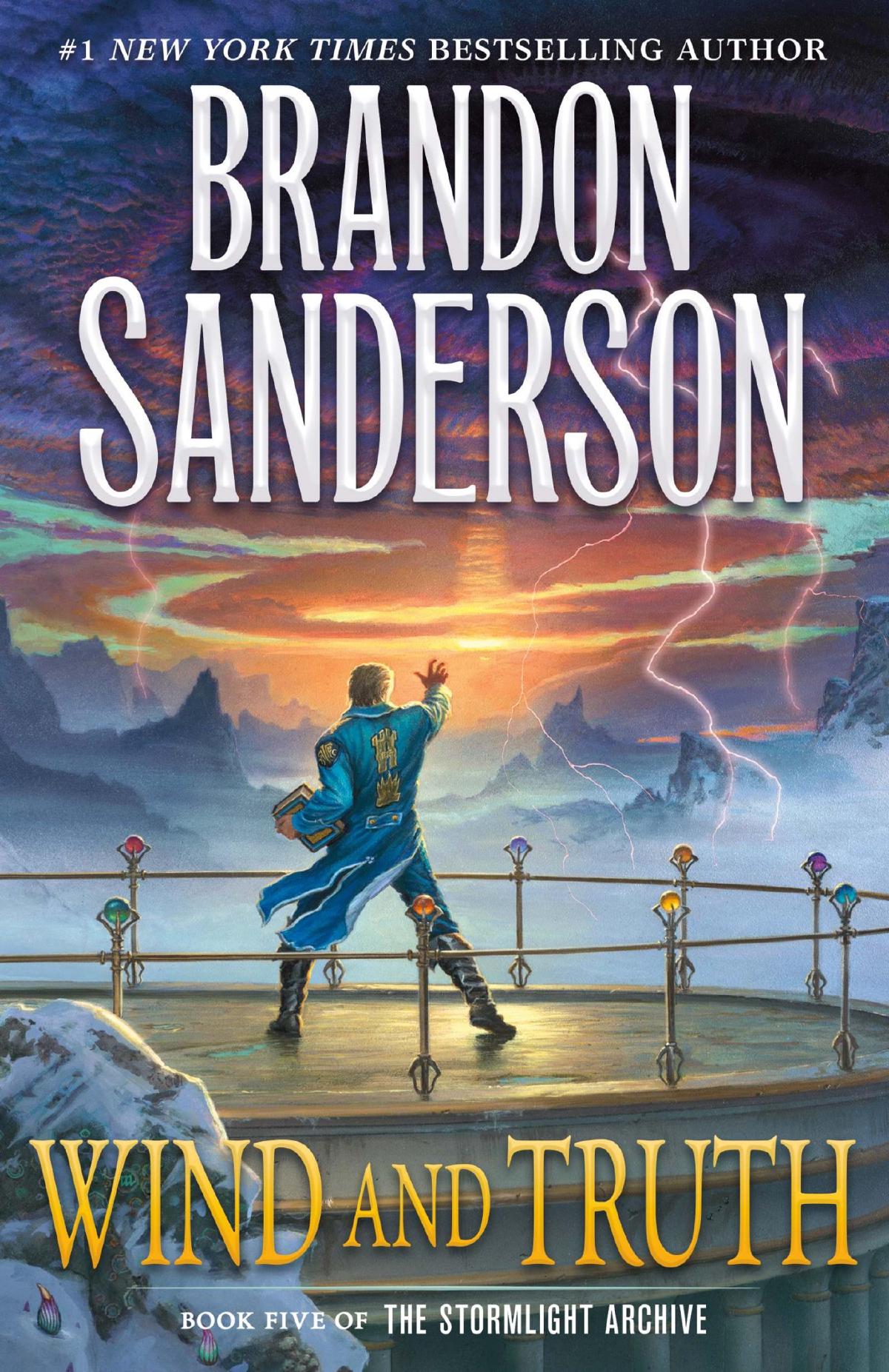
The Big One. I have no idea how to go about reviewing or writing about this one, but I guess I’ll try.
What an epic, incredible way to close out the first arc of The Stormlight Archive. Sanderson just hits you hard with everything: triumph, failure, depression, elation, and just an insane amount of Cosmere tie-ins. Some parts fell a little flatter than others but overal just an absolute banger. It’s hard to rank the Stormlight books because they’re all good. This one comes in third for me, behind Words of Radiance and The Way of Kings. I wasn’t quite sure how to organize this review so first I’ll do overall thoughts/impressions and then there are a couple of themes I think were essential to the book and obviously extremely important to Sanderson.
Overall Thoughts and Ramblings
#
I really enjoyed this book, and I think it was an excellent conclusion to the first arc of The Stormlight Archive. I understand some of the devisiveness that this book is causing, but I just did not feel that way at all. I do think the writing could have been a little tighter, and I think it could have been done in a way that kept all the storylines in tact. Mental health issues is one of the main traits of The Stormlight Archive, and I love it dearly because of that; but I do think some of it was over-explained and felt like Sanderson was maybe beating a dead horse a little bit, but overall it still worked for me.
Storylines. I really enjoyed most of them. Adolin, and Kaladin/Szeth’s storylines were the standouts for me though. Adolin’s arc over the last couple of books dealing with the fact that he isn’t a Radiant (but is still the best swordsman alive) was very enjoyalbe character development. His fight with the Thunderclast, playing Towers with the Emperor, and the will they/won’t they fight with Abidi. Adolin’s near-reverance with his swords and armor has been a through-line the entire series, the payoff of “unoathed”, while a bit cheesy, worked for me in the moment. My favorite scene in Rhythm of War was Maya during the trial yelling out, and to see that relationship come full circle with his armor, and Maya’s mission of getting more deadeyes to help was really satisfying. I’ll admit my expectation was for Maya to go get honorspren who could come and bond with a bunch of people to save the day. Having it be all deadeyes was much more fitting.
Kaladin becoming a Herald really worked for me as well. Kaladin is the character of the Stormlight Archive, I could not see Sanderson killing him off, or pushing him off to obscurity and not having extended influence not just on Roshar but across the entire Cosmere. Again, was it cheesy? Yes. Was “The Herald of Second Chances” kind of…meh? Also yes. But that entire scene of Kaladin becoming a Herald was super emotional for me and I can’t wait to see the storyline continue and get more heralds. I’m not convinced Battah isn’t going to try and betray them, though, given the interaction with Taravangian early on in the book. Along with Kaladin, seeing Syl’s growth of individuality as a spren was fun. After learning that she was learning how to write, I was convinced she was the other of The Knights of Wind and Truth (but, as is normal, all my predictions are wrong).
Szeth’s arc was satisfying. The flashbacks were fantastic and seeing his story of becoming Truthless, and all the betrayals along the way that made him incapable of making any choices was executed really well, I thought. The first two fights with the stonewarden and the fight in Shadesmar against the two honorbearers were cool, but all the other fights were kind of bland until the very end.
I’ve always liked Shallan even when she’s annoying. I think she’s one of Brandon’s best written characters, and I enjoyed her arc immensely in this book. The back and forth between her and the Ghostbloods was great. I loved the scene in the Shattered Plains when they infiltrated the Ghostbloods hideout, and the cat and mouse between her and Mraize and Iyatil was fun. Her realization that the manifestation of Formless was Iyatil was a surprise, and her lightweaving trick to finally kill Mraize was cool. I think it was during Oathbringer, I was convcined she was going to join the Ghostbloods and somehow become their leader…then I was convinced that was not going to happen, and now I’m not sure. Her interaction with Kelsier at the end leaves that storyline open, so that should be fun.
I was really confused with the whole Spiritual Realm storyline for Dalinar and Navani for a while and didn’t really know where it was going, but it got much better as the book went along. Especially when we got the flashbacks for Tanavast. The Contest of Champions was…fine. I’m not sure I would call it a letdown, but it was built up so much and it was fine. I didn’t love that Gavinor was the champion and that Odium did some funky time dilation-swap-the-baby-to-kill-his-grandpa thing. Oh well. Navani is in a coma? How will that affect the sibling? I dunno, man, at least towerlight still works?
Renarin and Rlain were great. Gernally I think Sanderson did a good job with this storyline and introducing gay characters (including Drehy). It feels heavy handed only because it was clearly a very deliberate choice. In his interview with Esquire, Sanderson explained not having a storyline like this would be more of a statement. I’m glad he did, it felt mostly natural and it worked for me. I think their unity in freeing Ba-Ado-Mishram is very important and am excited to see where it goes.
Jasnah continues to be excellent. It seems like quite a few people did not like her arc and the debate with Taravangian when she lost Fen as an ally. But it fits her character so well. During the entire thing she says how stimulating it is to be engaged in a debate like that. It would be weird if an intellectual exercise wasn’t part of her conflict with Odium. Brandon also confirmed that Jasnah will be the flashback character for Book 10. I think this is going to be much more consequential than we think.
Sigzil was fun, but that whole arc seemed kind of unimportant. I was very happy to get the background of how he lost his first bond, received the Dawnshard from Wit, and met Aux. It gives very important context to The Sunlit Man and leaves enough open to hopefully get the rest of that story sometime in the future.
Along with the Shattered Plains story, I just didn’t really care about Venli. I’ve never really liked her, and the back and forth of their allegiences just isn’t that interesting. The most interesting thing they did was find Odium’s well. That obviously will play a big part moving forward, especially since neither the humans, nor the singers control the land where it is located. I just don’t care about Venli.
I finally got interested in Lift, and we got so little of her. To be honest, I really just wanted more Vasher. Again, Brandon has said Lift is the flashback character in Book 6, so I hope we get her training montages with Vasher. Also no Vivenna (Azure) at all?
Why so little Moash? Getting Hemalurgy spikes is cool. But it just felt like he was not that significant. I really want a Moash/Marsh fight now.
Sanderson really swung for the fences on this one. I think he hit most of it out of the park. I don’t think his prose is as bad as some people think, I think it works for what he wants to accomplish, but again, I think it could have been tightned up a bit for this book and it would have been better. His romance is getting better, I think he handled Renarin and Rlain well, and we got a steamy shower scene. His worldbuilding and magic systems continue to be phenomenal. His humor continues to be hit or really miss with not a lot of in between.
Now, themes. There are a couple of themes that I think Sanderson really, really emphasized throughout this whole book: the ideas of Hope and Choice, and the concept of Momentum.
Hope and Choice
#
Right at the beginning of the book, in Chapter 4, we get one of my favorite chapters Sanderson has ever written. Sanderson has not been subtle about mental health in The Stormlight Archive, even more so in this book, but we get characters finally accepting themselves for who they are, and the conversation between Kaladin and Wit was so powerful to me. Kaladin is finally starting to accept that his depression will always be a part of him, but that he can still have good days and move on (a hard thing to finally accept for people with depression)…Kaladin is starting to feel hope, which is exactly what Wit talks about.
When everything feels wrong, all I can do is hope
-Wind and Truth, page 49
Syl brings up the Passions, which Wit explains is a set religious beliefs derived from Odium which apparently professed that if someone cares enough, one’s emotions will influence success. That if someone wants something enough, that the Cosmere will provide. Wit’s explanation is that hope, as a virtue is not completely compatible with the Passions. Wit defines a virtue as:
something that is valuable even if it gives you nothing. A virtue presists without payment or compensation. Positive thinking is great. Vital. Useful. But it has to remain so even if it gets you nothing. Belief, truth, honor…if these exist only to get you something, you’ve missed the storming point.
-Wind and Truth, page 50
Just an excellent discussion about hope. This really sets up the entire journey of (at least) Kaladin for the entire book. It’s all hope, and Kaladin is constantly given nothing in his hopeful determination to help Szeth, Nale, and others. His is a test in virtue, and he mostly succeeds. But this chapter was really just such a thought provoking and powerful chapter for me. I must have been in just the right mood and state of mind when reading it becasue I was absolutely floored by this conversation between Kaladin and Wit.
Continuing on that theme of negotiating with ones faith, beliefs, and purpose, Odium’s first interlude is excellent. Not only do we see Taravangian coming to grips with the power and desire of Odium, but it shows him trying to balance out his personal desires with the desires of the Shard defined by an overwhelming amount of hate (passion and emotion as Odium calls it). Taravangian and Cultivation have a nice little discussion about free will, suffering, and we get a whole lot of information about how vessels interact with their Shards. Taravangian is not like his predecessor; he, as the vessel, has seemingly good intentions and you can understand why he wants to control, or severly limit people’s choices—he wants to stop suffering throughout the cosmere. He’s not wrong when he says “there is a spectrum of choice that can bee allowed. No society can persist with complete freedom, and growth can happen within limits” (page 126), but it’s clear he wants to control it to such a degree that there will be no suffering when he continues to explain “I can make it so that free will exists to an acceptable degree, while also preventing famine” (pag 126). Taravangian wants to allow choices that exclude the possibility of suffering. Cultivation (I would argue rightly) tries to explain that freedom without potential consequence is not freedom at all. This reminds me so much of a conversation between Aziraphale and Crowley in Good Omens when Aziraphale is explaining choice to Crowley, “people couldn’t become truly holy, unless they also had the opportunity to be definitively wicked.” Taravangian’s grand plan of “limited choice” would also limit all potential within the Cosmere itself.
I think we also get some foreshadowing here when Taravangian believes he is not Odium, he is still Taravangian and he will not let the Shard rule him. In Tanavast’s (Honor) flashbacks later on in the book, we see what happens when a vessel tries to control and shape the Shard as they desire. Tanavast was eventually rejected by Honor. Honor abandonded Tanavast because he broke oaths when he executed his plan to imprision Ba-Ado-Mishram (among other decisions that went against Honor’s nature).
But in that moment, the moment she was captured, the power I held—the power of Oaths, bonds, and promises…It rejected me.
-Wind and Truth, page 1129
Rayse tells Tanavast that he was too weak to bend Honor to his will. I am very curious if this is foreshadowing Taravangian’s journey of being Odium’s vessel.
On the opposite end of this, is Kaladin’s journey with Szeth. We finally learn why Szeth became utterly incapable of making choices and why he demands to be told what to do and what to choose. Szeth’s flashback sequences were incredible. His journey in becoming Truthless, and the redemption arc into being Truth was some of the most enjoyable parts of the book. Kaladin learning to become a therapist to Szeth, and eventually all of the Heralds and proclaiming the fifth ideal was so good. Szeth is constantly asking what is the right thing to do, both in his flashbacks and now with Kaladin. His greatest desire is to know truth and to make right decisions. This, in turn, makes him incapable of making any decision and coming to understand for himself what is right. Kaladin only wants him to choose. It doesn’t matter if the choice is right or wrong, Kaladin only wants Szeth to make a choice so that he can finally learn and understand what is right (or wrong) for himself. Where Odium wants choice within limits prescribed by him, Kaladin stands for choice for the sake of choice; for the sake of knowledge and the clarity that making a choice, even the wrong one, can bring.
Likewise, Renarin and Rlain’s storyline is also centered around this idea of choice. Not only is Renarin trying to work through his feelings and decide to take a chance with Rlain, their choice to finally take a chance with each other directly impacts the climax of their arc: the freeing of Ba-Ado-Mishram. They made the choice together, singer and human, and together, presented in unity, they may have convinced Mishram to not kill all the humans? I don’t know. This will clearly be a developing storyline in the second arc of The Stormlight Archive. But I think Renarin/Rlain played, and might continue to play, an integral part in convincing Mishram not to just kill all humans.
Some are evil, some are good. Most are both! Just like us, and until we accept that, nothing will ever change.
Wind and Truth, page 1265
Dalinar realizing that Taravangian had put him in a position of losing either way and choosing to revoke his oaths was cool, and was a great way to not completely lose to Taravangian. Dalinar and the Stormfather finally connect, and the Stormfather chooses to accept Dalinar revoking his oaths. Just like with Tanavast, this causes Honor to abandon Dalinar and Taravangian chooses to take up the second shard and become Retribution. Dalinar’s mission to “unite them” may have ended in uniting a different “them” than he intended: uniting the entire rest of the Cosmere and the shards to FINALLY pay attention to Odium, now Retribution. Dalinar gave Roshar a hope and a chance of survival.
There are plenty of other examples of this idea of Hope and Choice through the book. Fen choosing to ally with Odium; Jasnah choosing to give land in the Shattered Plains to Venli; Szeth choosing literally anything, etc. But these were the examples that I felt were really apparent and emphasized by Sanderson.
Momentum
#
This idea of momentum kept coming up throughout the book, and I am really curious about it. The first mention of momentum in the book is in Chapter 2, when Kaladin is described as “deciding to take the next step, rather than being thrust into it by momentum or crises” (page 37). Then we get Dalinar who “stormed forward, keeping momentum, as had always been his way” (page 147). Adolin explains that “singers attack through aggression and momentum” (page 327) and that the singers “relied on momentum, intimidation, and strength to overwhelm” (page 389). And finally, we get the way Sanderson is defining momentum in this sense in a Szeth flashback scene during Day 5:
Szeth refused to be caught in the momentum of life, or of battle. Momentum carried those who didnt wonder, didn’t stop to question. Questions like “What is right?”
-Wind and Truth, page 553
Momentum in life, to Sanderson, is an unquestioning, uncurious, and ultimately unfulfilling existence. People can get by with momentum—we are constantly reminded about Dalinar’s entire life of momentum as the Blackthorn, killing first and never ask questions later.
He’d always stubbornly insisted he was right. Momentum. His life had been about momentum. Problem was, it was all to easy to gather momentum in the wrong direction, and it bacme harder and harder to change course.
-Wind and Truth page 1151
Sometimes momentum in this sense is necessary; Adolin realzing “a battle is about momentum” (page 628), and given his superior strength in shardplate and skill as a shardbearer, he was able to win a single battle in a larger war based on his own momentum. However, unlike his father for most of his life, Adolin demonstrates he is able to stop and question and alter tactics instead of being carried away by momentum.
Kaladin, while trying to convince Nale about how the law does have shortcomings uses the same language related to momentum, “A lot of laws and rules were the same—retaining their positions by merit of momentum, not virtue” (page 891).
It was just so interesting to me that Sanderson was clearly so focused on this idea of the “momentum of life”. And this ties in so well with the idea of choice. Every character in this book had to deal with the momentum of life. Every character made deliberate choices to either continue move with that momentum, or to stop and question or wonder “what is right?”. I don’t think Sanderson is trying to provide an answer. I think his point is to learn the lesson in our own lives to not get caught in the moment of life. It’s okay to stop, question, wonder, and make choices accordingly. We can hope for answers, though nothing may come of it, but we have the option of choosing to know what is right for ourselves.
One thing really became apparent to me while reading the book. It’s interesting, I don’t think Sanderson is overly preachy in his books, at least not explicitly so. However, being Mormon like he is, it’s so fascinating to see some of his…sermonizing in his writings…and there’s a lot in this book. No, I don’t think he’s trying to convert anyone, and he’s not outright evangelizing or even discussing beliefs or ideas that are exclusively Mormon; however, knowing the religious context he’s writing from, I can see him working through his own thoughts and beliefs through his writing. As someone who is also constantly negotiating my own faith, I think he balances it out pretty well, though I’m sure some would disagree. Maybe that’s why parts of this book resonated so well with me, espeically the parts about hope, choice, and momentum.